What Size Watch Should You Wear? Case Size, Wrist Fit, and Proportion in 2026
As an Amazon Associate I earn from qualifying purchases. Prices and availability are accurate as of the date/time indicated and are subject to change.
How we picked: This guide compares options using published
specifications, verified owner-review patterns and reputable expert testing.
We label clearly what is hands-on vs research-based, and never present others'
testing as our own.
Our top picks
| Rank | Product | Name | Why we picked it | Buy |
|---|---|---|---|---|
| Top pick |  | Casio MDV106 'Duro' (~44mm — a versatile mid-large everyday size) | Check price |
The single spec that decides whether a watch looks great or awkward on you isn’t the brand or the dial — it’s case size relative to your wrist. A watch that’s stunning in photos can look like a wall clock on a slim wrist or a coin on a broad one. And despite years of “bigger is better” marketing, proportion is what actually reads as stylish. Here’s how to size a watch to your wrist so it sits like it belongs there.
The numbers that matter (and how to measure)
Three measurements decide fit:
- Case diameter (the headline number): typically 38–42mm suits most wrists, with smaller wrists leaning 36–40mm and larger wrists carrying 42–46mm comfortably.
- Wrist width: measure around your wrist with a tape. As a rough guide, wrists under ~6.5” look best with 34–40mm; 6.5–7.5” with 38–42mm; over 7.5” can handle 42mm+.
- Lug-to-lug distance (the length across the case): arguably matters more than diameter — if the lugs overhang the edges of your wrist, the watch is too big regardless of the diameter number.
Beyond diameter: thickness and lug width
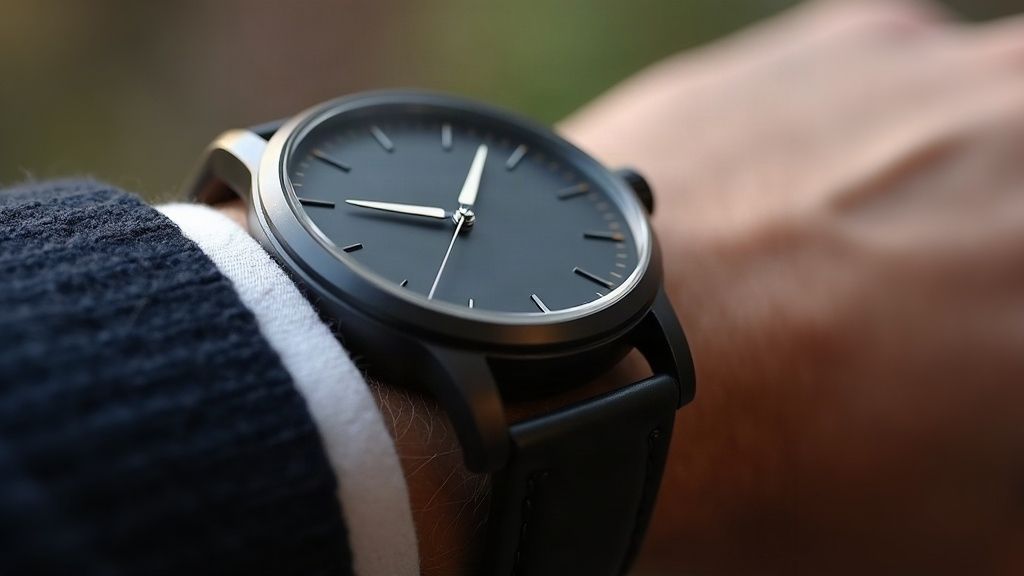
Two often-ignored specs finish the fit:
- Thickness: a thick case slides under cuffs poorly and looks chunkier than its diameter suggests. Dive watches (like the ~44mm Casio Duro) run thicker by design — fine as a sporty everyday piece, less so as a dress watch.
- Lug width (strap width): determines the straps you can fit and the overall balance. Wider lugs suit bigger cases; a mismatch looks off.
Judge a watch by how the whole package sits, not one diameter number.
What size watch is best for my wrist?
Match diameter to wrist circumference: under 6.5” → ~34–40mm; 6.5–7.5” → ~38–42mm; over 7.5” → 42mm+. But check lug-to-lug too — if the lugs overhang your wrist, size down even if the diameter “should” fit. Proportion beats any single number.
Is a 42mm watch too big?
For an average-to-larger wrist (~7”+), 42mm is a versatile, common size. On a slim wrist (~6.25”) it can look oversized, especially if it’s also thick with long lugs. Try to see the lug-to-lug against your wrist — a 42mm with short lugs can wear smaller than a 40mm with long ones.
Does watch size affect style?
Yes. A well-proportioned watch reads as intentional and refined; an oversized one reads as a gadget. For versatility, a mid-size (~38–42mm) works across casual and dressier looks — see how occasion shapes the choice in our automatic vs quartz guide and, for sportier options, best affordable dive watches.
The wrap-up
Size a watch to your wrist, not to the trend: check diameter, lug-to-lug, and thickness together, aim mid-size for versatility, and remember proportion beats “big.” If the lugs sit within your wrist and it slips under a cuff, it fits — check the listed case dimensions before you buy.